Analog Summing ResourcesWhat follows is a collection of articles, videos, and forums on the benifits of analog summing versus mixing strictly in the box.
Articles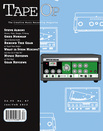
Excerpt "Some newer recordists might ask, "Why would you not want to mix this ITB?" Almost everybody I've met who works as a professional recording engineer will agree that mixing through an analog console usually sounds better. However, many professional engineersdo mix ITB. Reasons include repeatability, recall and the ability to please clients and record labels. Labels often ask engineers to be able to recall any mix instantly and make a minor change. This has become expected in the music industry at all levels. But still, I've never heard anybody say, "I mix in the box because it sounds better." Never. -JB Read the rest of this article ...here on the TapeOp Website.
Exerpt "So was there a difference? Yes, and my vocabulary is about to sound the same as everyone elses: the analog summed mix is wider, deeper, more musical, more spacious, etc… Especially apparent to my ears is the detail in the effects, the delays and reverbs. They seemed more audible in general, but also more spacious." Read the rest of the article ...here
Excerpt "A growing number of proponents of summing their DAW mixes in analog say they're much happier with the overall sound of their mixes. Claims of a “more open, clear and punchier sound” are common, with the main consensus that (given a high-quality summing unit) the mix sounds like it was done on a very expensive Neve, API or SSL analog console. The best of both digital and analog worlds, the rising popularity of this method is self-evident' Read the rest of the article ...here Forums
Video
Terry A., Head Designer and Engineer for Unit Audio has this to say About Analog Summing:
“Loosely quoting Shakespeare one might say ‘To analog sum or not to analog sum?’ This has been a point of controversy with digital recording for quite some time.
With modern DAW software, mixing within the computer has resulted in some great sounding recordings, but I have long been intrigued by the concept of analog summing. I was not prepared to pay $800.00 or more to test that theory, so I engineered and built my own. Then to test the theory, I set out to see if there was any difference in the mixed sound. Much to my amazement and pleasure, I did notice a subtle but very pleasing difference in the stereo separation and placement of the instruments compared to my In the Box mixes." IN CONCLUSION Is analog summing going to make your recordings sound like a Nashville studio with a billion dollars worth of equipment? Probably not, but you will notice a difference in your mixes using a Unit Audio summing mixer. The Unit Audio summing mixers are pretty simple to set up. Once you have the mixer connected it can simply stay in your recording mix path. There really is no need to disconnect it. All you have to do is run cables out of your converter outputs to the Unit Audio summing mixer balanced line inputs. You then run cables out of the Unit Audio summing mixer balanced microphone level outputs into two channels of your microphone preamp. It is a good idea to have both preamp channels be alike. The microphone pre that you use dictates the final sound that you will get in your mix. The final stage of setting up is to come out of your microphone pre into two input channels of your converter and mix to stereo in your DAW. Because of the passive circuit in the Unit Audio mixers, there will be about 30db of gain loss. This is why you need the mic pre at this stage. The really pricey summing mixers have make up gain built in which in turn creates a final mix of whatever coloring that particular circuit adds. By using your own preamps you can adjust your final mix sound by the character of each individual pre amp. It is pretty cool. I will be happy to answer any questions you might have about set up, or anything. Send an email to terry@unitaudio.com, or use the email submission form on the contact page. Terry |
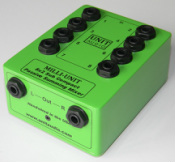
Unit Audio Milli-Unit
Priced at only $149.00*
The Milli-Unit is our entry level mixer with all the basic features you need to add that analog sparkle and punch to your ITB recordings ....more *plus shipping. 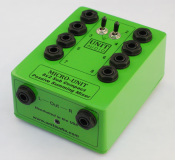
Unit Audio Micro Unit
The Micro-Unit is our upgraded 8 input mixer that shares all the basic features of the Milli-Unit, plus 2 pan switches for additional mix flexibility. ...more
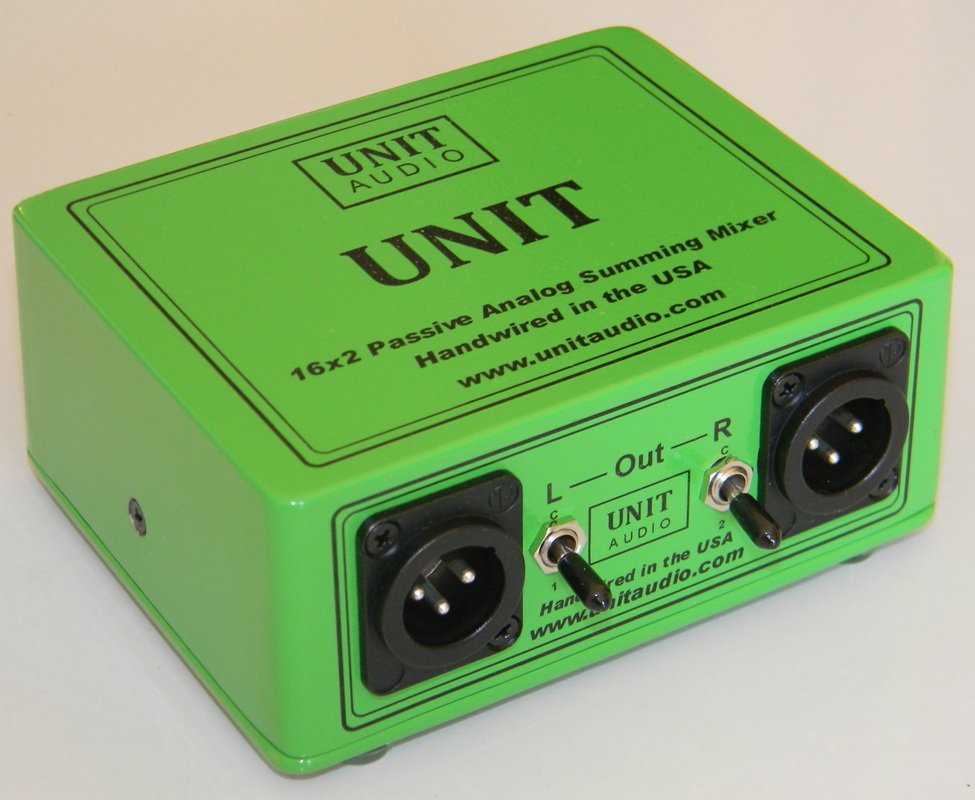
Unit Audio New Unit 16 x 2
|

Unit Audio makes high quality affordable passive summing mixers and acoustic control for home recording and project studios.
Nashville, TN USA 2012